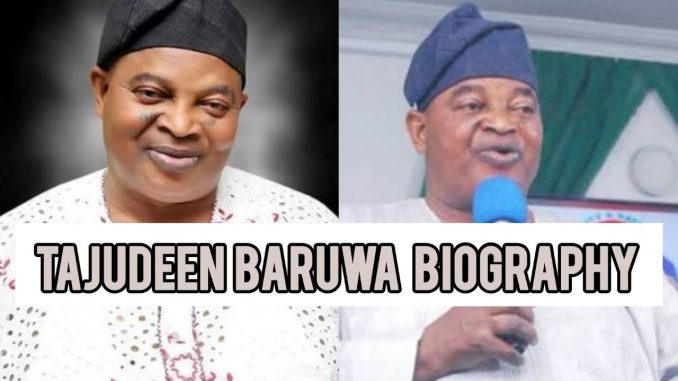
Tajudeen Baruwa Biography
Tajudeen Baruwa was born on April 19, 1965, in Ogun State, Nigeria. A 2019 Tribune profile described him as coming from the family of Mr. and Mrs. Ibikunle of the Kushoro royal family in Ilogbo, Ado-Odo/Ota Local Government Area of Ogun State. That same profile said he completed his primary and secondary education in Ado-Odo/Ota and then moved into transport work after secondary school. Tajudeen Baruwa is 60 years old as of 2026.
The early part of Baruwa’s life is tied closely to the road transport business. The Tribune profile said that after school, he started as a bus conductor in Ikeja, Lagos State. That experience helped him learn how transport operations work from the ground level. It also helped him understand the people, the challenges, and the daily pressure that come with public transport in Nigeria. For many supporters, this is one reason he is seen as a grassroots leader who knows the sector from inside, not from a distance.
Some public descriptions of Baruwa also call him “Alhaji,” which usually suggests Islamic faith in Nigerian public life. However, reliable public reports reviewed for this article do not give a full verified statement about his religion, wife, children, or wider private family life. What is clear from the available reports is that he has built a public identity around transport union leadership, legal battles, and union administration rather than personal display.
By 2019, he was already being described in the press as the new president of NURTW, and the same year’s profile portrayed his rise as a journey from humble beginnings to national visibility. A later report in 2023 said he was re-elected for another four-year term, showing that his influence had not only survived but grown within the union structure. His public image, therefore, is that of a man who moved from local transport work to national leadership through persistence and union politics.
Tajudeen Baruwa Career
Baruwa’s career is rooted in the transport sector, and that is where his name first gained serious attention. According to the Tribune profile, after beginning as a bus conductor in Ikeja, he moved into union-related duties and became a park agent at the Ikeja branch of NURTW. That early stage matters because it shows how he climbed from the base of the transport system into a position where he could influence decisions, rules, and leadership inside the union.
From there, his career rose step by step. The facts supplied for this article say he served as a financial secretary, unit chairman, branch financial secretary, and branch chairman in Ado-Odo/Ota. These roles show a steady rise inside the union structure. They also explain why he later became a major name in Ogun State and beyond. A leader does not usually become important in a day; in Baruwa’s case, the picture presented by public reporting is of a man who built power slowly, position by position.
His rise did not stop at the branch level. Public reports say he later became chairman of the Ogun State NURTW Council for two terms. The facts supplied for this article also say he served as zonal chairman for Zone 2, which covers Lagos, Ogun, Oyo, Ondo, Ekiti, and Osun. That made him an important figure across a wide part of southwestern Nigeria, not just in his home state. A leader with that kind of reach can shape how a union works on the ground, especially in a sector as large and politically sensitive as road transport.
At the national level, his career moved even higher. The facts provided say he served as Assistant Treasurer, National Treasurer, Vice President, and then National President of NURTW. Public reports confirm that he was re-elected as president in 2023 for another four-year term, and that a 17-member National Administrative Council was also elected with him. This shows that, at least within the union structure, he remained a central figure with a strong support base.
His presidency became especially important because NURTW is not just a trade union. In Nigeria, it also carries influence in transport control, local union politics, and sometimes wider social and political discussions. That is why Baruwa’s position has attracted attention far beyond the transport world. By 2024 and 2025, reports repeatedly showed that his leadership had become tied to court rulings, official recognition, and factional conflict. In other words, his career is not only about office titles; it is also about authority, legitimacy, and control.
In February 2025, TVC News reported that Baruwa’s faction asked President Bola Tinubu to intervene in the leadership crisis in NURTW. That report said the dispute had been running for more than two years after the 2023 election. It also showed that Baruwa was still actively defending his claim to the union’s top job and was still speaking like a leader who believed the courts had already settled the matter.
By March 2026, the career story had taken another dramatic turn. News reports said the Baruwa-led faction moved to take back the union’s national secretariat in Abuja after citing court judgments in his favour. The Cable and Punch both reported that police later arrested Baruwa and other suspects after the takeover attempt, while the police said they had received a distress call and that the incident involved a large crowd and injuries. This made Baruwa not just a union leader in the news, but one of the most discussed labour figures in the country at that time.
Tajudeen Baruwa Scandal and Controversies
The biggest controversy around Tajudeen Baruwa is the long-running struggle over NURTW leadership. The dispute became public after rival camps emerged over who had the right to control the union. On one side was Baruwa and his supporters; on the other side were loyalists linked to Musiliu Akinsanya, popularly known as MC Oluomo. This fight has not been a small internal disagreement. It has grown into a national issue because it involves legal rulings, union control, and public order.
Court decisions have played a major role in the controversy. The National Industrial Court, in March 2024, affirmed Tajudeen Baruwa as the re-elected president of the union and declared the caretaker committee illegal. Later, the Court of Appeal in Abuja upheld that decision in November 2024 and dismissed the appeal brought by rivals. Reports said the appeal lacked merit and that the court even awarded costs against the appellants. These rulings gave Baruwa legal backing, but they did not fully end the crisis in practice.
That gap between court judgment and real-life control is what made the controversy even bigger. Reports in late 2024 said Baruwa’s camp treated the inauguration of MC Oluomo as unlawful and said it violated existing court orders. Later reports in 2025 and 2026 showed that the dispute still had not settled down. This tells a clear story: even when the courts speak, the people involved in a power struggle may still fight over who truly controls the space.
The March 2026 secretariat takeover became the most dramatic part of the scandal so far. Punch, The Cable, Daily Post, and other outlets reported that Baruwa led members of his faction to the NURTW headquarters in Abuja to enforce what he believed was a valid court order. The police, however, said about 300 people stormed the premises, that the scene became violent, and that seven suspects, including Baruwa, were arrested. This event turned the leadership dispute into a public security issue, not just a union matter.
The police also pushed back against claims that their officers shot at NURTW members. According to the FCT Police Command, those claims were false and misleading. The command said its officers responded to a distress call and found people armed with cutlasses, bottles, bows, and arrows. One person reportedly suffered severe machete wounds, while others were taken for treatment. These details matter because they show why the story remained controversial: each side told a different version, and public debate grew around who was right and who crossed the line.
There was also an earlier controversy in 2023 when Punch reported that Baruwa and others were arrested over an alleged killing. That earlier arrest added to the public image of a union leader whose career had become closely linked to conflict and police action. When people search for “Tajudeen Baruwa scandal” or “Tajudeen Baruwa controversies,” they are usually referring to this wider pattern of court disputes, leadership battles, arrests, and union tensions.
Still, it is important to separate facts from noise. The public record reviewed here shows that Baruwa has court rulings in his favor and a long union career built over many years. It also shows that the opposition camp has repeatedly challenged his authority. So the controversy is not only about one man’s behavior; it is also about a deeply divided union, competing loyalties, and the struggle to control a powerful organisation.
Conclusion
Tajudeen Baruwa’s biography is a story of rise, power, law, and conflict. He began in the transport world, worked his way up through union positions, and eventually became a national leader in NURTW. Public reports show that courts affirmed his leadership, but the fight over control of the union continued for years and reached a dramatic peak in March 2026 with the Abuja secretariat takeover and arrests. Whether people see him as a strong union man or a controversial figure, one thing is clear: Tajudeen Baruwa remains one of the most important names in Nigeria’s transport union politics.
Frequently Asked Questions
What is Tajudeen Baruwa known for?
Tajudeen Baruwa is best known as a top leader in the National Union of Road Transport Workers, where he rose from grassroots transport work to become national president. He is also known for the long leadership crisis inside NURTW and the court battles linked to that crisis.
Where is Tajudeen Baruwa from?
Public reporting says he is from Ilogbo in Ado-Odo/Ota Local Government Area of Ogun State, and that he comes from the Kushoro royal family. The facts supplied for this article also place his birth in Ogun State.
How did Tajudeen Baruwa start his career?
He started in transportation after secondary school and worked as a bus conductor in Ikeja, Lagos. After that, he entered union work and rose through several NURTW leadership roles.
Why was Tajudeen Baruwa arrested in 2026?
News reports say he was arrested after leading a faction to take over the NURTW national secretariat in Abuja. The police said the action became violent and led to arrests, injuries, and later court processing.
Is Tajudeen Baruwa still the recognised NURTW president?
Court reports in 2024 affirmed Baruwa as the duly elected or authentic president of NURTW, and later news in 2026 still referred to him as leading a faction that claimed control of the union secretariat. The public record shows that his legal position was upheld, even though the union dispute continued in practice.
Originally posted 2026-03-23 22:03:29.

Henry Jude writes about biotechnology and housing technology, focusing on the latest trends. He has 15 years of experience reporting on and analyzing advances in these fields. Holding both a BSc and an MSc in Biotechnology, he uses his scientific training to explain complex ideas clearly and show how new technologies can be applied in real life.