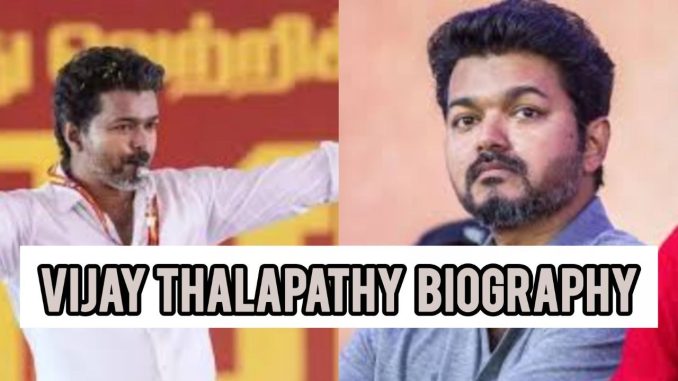
Vijay Thalapathy Biography
Vijay Thalapathy was born on June 22, 1974, in Tamil Nadu, India. He was born into a film family, the son of director S. A. Chandrasekhar and his wife Shoba Chandrasekhar, and cinema was never just an aspiration for him — it was the atmosphere he was raised in. That environment gave him an early head start and a lifetime of understanding the craft from the inside, something that would later be visible in the range and instinctiveness of his performances. Vijay Thalapathy is 52 years old as of 2026.
He attended school in Chennai and later enrolled at Loyola College, one of the city’s most respected institutions, where he studied Visual Communications. He did not complete the degree, choosing instead to commit fully to acting — a decision that, given the arc of his career, is difficult to argue with. He later received an honorary doctorate in recognition of his contributions to Indian cinema, a formal acknowledgment of what millions of fans had long since decided on their own terms.
Vijay is of Tamil ethnicity and is believed to be Christian, though he is widely known for visiting temples and mosques and showing respect across religious traditions — a quality that has served him well both as a public figure and, eventually, as a politician.
He married Sangeetha Sornalingam in 1999, and the couple has two children: a son, Jason Sanjay, and a daughter, Divya Saasha. Both children have been kept largely out of the public eye, a reflection of a private instinct that has coexisted, sometimes uneasily, with the enormously public life Vijay has led. Reports in 2026 of a divorce after more than two decades of marriage generated significant media attention and online discussion, though the specifics remained a matter of public speculation rather than confirmed fact.
His net worth is estimated at over ₹600 crore — roughly equivalent to more than $70 million — accumulated through decades of blockbuster films, brand endorsements, and more recently through his political and business ventures. He is consistently ranked among the highest-paid actors in Indian cinema, a distinction that reflects not just his commercial power but the cultural authority he commands in Tamil Nadu and well beyond its borders.
Vijay Thalapathy Career
Vijay made his first appearance on screen not as a young man with ambitions but as a child. He debuted as a child artist in the 1984 film Vetri, directed by his father, and appeared in several of his father’s productions during his formative years. That childhood in cinema gave him a fluency in front of the camera that would later make his transition to lead roles appear almost inevitable.
His debut as a lead actor came in 1992 with Naalaiya Theerpu, but it was the second half of the decade that truly established him as a star. Films like Poove Unakkaga (1996), Kadhalukku Mariyadhai (1997), and Kushi (2000) brought him to the romantic hero phase of his career, earning him a devoted fan base among younger audiences and establishing his screen chemistry with leading actresses of the era. These were not merely commercial hits — they were films that put Vijay’s name on the lips of an entire generation growing up in Tamil Nadu.
The transformation into a mass action superstar came in the 2000s. Ghilli (2004) and Pokkiri (2007) redefined his public image and gave Tamil cinema some of its most memorable punch dialogues. Lines like “Nee padicha schoolla na headmaster da” from Pokkiri — loosely translated as “I am the headmaster of the school where you studied” — captured the style, swagger, and wit that would come to define his mass appeal. Another beloved line from the same film, “Oru vaati mudivu pannitena en pecha nanae kekamaten” (“Once I make a decision, I won’t even listen to my own words”), struck a chord for its combination of confidence and conviction.
From Ghilli came the motivational “Thamaa thundu blade mela vacha nambikaiya vai un mela vai jeikalam” — a line urging self-belief in place of relying on a tiny blade — which resonated deeply with young audiences navigating their own difficulties. His dialogue from Thirumalai, “Vaazhkai oru vattam da… Ethula thokkaravan jeipan, jaikiravan thoppan” (“Life is a circle — the person losing today will win someday, and the winner will lose”), became a staple in motivational videos and social media posts for years. These lines were not simply written well — they were delivered with the particular intensity and authenticity that made Vijay’s screen presence impossible to replicate.
The superstar era that followed produced some of Tamil cinema’s biggest commercial milestones. Thuppakki (2012), Mersal (2017), Master (2021), and Leo (2023) each broke records, generated cultural conversations, and reinforced Vijay’s standing as the defining mass hero of his generation. His films are known for combining social messaging with high-octane entertainment — a formula that reflects both the commercial instincts of his collaborators and his own carefully cultivated public image as a protector of the underdog and a voice for ordinary people.
Beyond acting, Vijay is a trained dancer, a playback singer who has lent his voice to several of his own films, and a philanthropist whose charitable activities have been extensive and sustained. His fans, organised into a massive global network, regularly participate in blood donation camps, disaster relief efforts, and educational support programmes — activities that have over time blurred the line between fan club and welfare organisation, and which formed the grassroots foundation for what would eventually become a full-scale political operation.
Vijay Thalapathy Personal Life
Vijay Thalapathy is married to Sangeetha Sornalingam, in 1999 was a stable and largely undramatic part of his public profile for over two decades — a background fact rather than a focal point. Their children were raised away from the camera, a choice that reflects a set of personal values about privacy that Vijay has maintained even as he has embraced more public-facing roles in politics.
The 2026 reports of a divorce, coinciding with his political breakthrough, added a complicated personal dimension to what was already a transformative year. The timing — with his party making history in Tamil Nadu elections — ensured that the personal and political became intertwined in the public imagination in ways he could not entirely control.
Adding to the media noise were persistent rumours about his relationship with actress Trisha Krishnan, with whom he had acted in several films — a dynamic that drew obvious comparisons with the famous and complicated story of MG Ramachandran (MGR) and J. Jayalalithaa, the two AIADMK titans whose personal and political lives were long intertwined in the public memory of Tamil Nadu.
Trisha was spotted at Vijay’s residence on May 4 when TVK was closing in on victory — and it happened to be her birthday. Earlier, on election day, she had shared a photograph of her ink-stained finger with a Vijay film song playing in the background. Neither Vijay nor Trisha commented on the rumours, but the optics were impossible to ignore for a media and public already primed to draw the MGR-Jayalalithaa parallel.
“There are so many jackals and other animals in the forest but there will be only one lion. And even if it is single, it will be the king of jungle.” — Vijay Thalapathy, at a TVK election rally
Vijay Thalapathy Tamil Nadu Election 2026
The political story of Vijay Thalapathy did not begin in 2024 with the formal launch of his party. It began much earlier, in 2009, when he converted his fan network into a structured welfare organisation called Vijay Makkal Iyakkam (VMI). Over the following decade and a half, VMI grew into a network of over 85,000 units across Tamil Nadu, conducting blood donation camps, disaster relief operations, educational support drives, and a range of social welfare activities that quietly but steadily deepened Vijay’s connection to the communities that would one day become his voters. In 2021, VMI members contested local body elections as independents and won 115 seats — a result that told the political world what was coming.
Vijay formally launched Tamilaga Vettri Kazhagam (TVK) on February 2, 2024, declaring his intention to contest the 2026 Tamil Nadu Assembly elections. The party’s first major conference in Vikravandi in October 2024 drew around 8 lakh people — a gathering of a scale that made even the established parties take notice. TVK drew ideological inspiration from BR Ambedkar, Periyar, and Kamaraj, adopted the slogan “Pirappokkum ella uyirkkum” (Equality for all beings), and chose the Vaagai flower as its symbol — a gesture rooted in Tamil cultural tradition that signified victory.
The period leading up to the election was not without its difficulties. On September 27, 2025, a tragic stampede at Vijay’s first poll rally in Karur resulted in 41 deaths and over 80 injuries — a devastating event that could have derailed the campaign. His upcoming film Jana Nayagan, directed by H Vinoth, faced delays, plagiarism claims, and online leaks, generating both negative press and intense fan engagement simultaneously.
Reports of his divorce and the Trisha rumours kept him in the centre of media attention throughout. Yet TVK’s campaign only gained momentum. Vijay’s decision to make a full and announced exit from films, positioning TVK as a serious and permanent political project rather than a side venture, gave the party a credibility that Kamal Haasan’s Makkal Needhi Maiam had never quite established. Where Haasan had relied on urban appeal and an anti-corruption pitch, Vijay built a state-wide, grassroots, welfare-centred campaign that reached voters across social and geographic lines.
The results of the 2026 Tamil Nadu Assembly elections were extraordinary. TVK emerged as the single largest party, winning approximately 107 seats — eclipsing both the DMK (approximately 59 seats) and the AIADMK (approximately 47 seats) and reshaping Tamil Nadu’s political map in one election cycle. It was a result that stunned political analysts and validated the decade-long groundwork that had preceded the official party launch. Fans celebrated with the kind of energy usually reserved for blockbuster releases, and the song “Vaathi Coming” — iconic from his film Master — became the soundtrack of the victory celebrations.
The parallel with MG Ramachandran was hard to avoid. MGR had transformed cinematic charisma into political capital, built the AIADMK in 1972, and become Chief Minister in 1977. Vijay’s journey echoed the pattern — mass hero roles consistently portraying him as a protector of the ordinary person, a fan base that functioned as an organisational network, and a first election that rewrote the rules of Tamil politics. The key difference, as observers noted, is context: MGR entered a political vacuum in the 1970s, while Vijay has broken through a mature, competitive, alliance-driven modern political landscape. And he did it as a one-man party, leading from the front in his very first electoral contest.
Yet TVK fell short of a clear majority, and the question of alliances loomed large in the aftermath of the results. Vijay himself had spoken of the lion who needs no allies — but arithmetic, as Tamil Nadu politics has always known, has its own demands. What comes next for the self-styled lion of TVK is the political story that all of India is watching.
Conclusion
Vijay Thalapathy’s life has moved through phases that most people experience only one of: gifted child actor, national romantic hero, mass superstar, cultural icon, and now a political force that has redrawn the electoral map of Tamil Nadu. At 51, he carries the accumulated weight of more than three decades in the public eye, the grief of personal losses, the noise of controversy, and the extraordinary validation of a political debut that exceeded almost every prediction. Whether the lion of TVK can navigate the alliance mathematics of Tamil Nadu governance and deliver on the promises his campaign was built on is the next chapter — and if his story so far is any guide, it will be one worth watching closely.
FAQs
What is Vijay Thalapathy’s political party?
Vijay Thalapathy founded Tamilaga Vettri Kazhagam (TVK) on February 2, 2024. The party draws ideological inspiration from leaders like BR Ambedkar, Periyar, and Kamaraj, uses the Vaagai flower as its symbol, and carries the slogan “Pirappokkum ella uyirkkum” (Equality for all beings). In the 2026 Tamil Nadu elections, TVK became the single largest party, eclipsing both the DMK and AIADMK.
Originally posted 2026-05-04 17:12:09.

Henry Jude writes about biotechnology and housing technology, focusing on the latest trends. He has 15 years of experience reporting on and analyzing advances in these fields. Holding both a BSc and an MSc in Biotechnology, he uses his scientific training to explain complex ideas clearly and show how new technologies can be applied in real life.