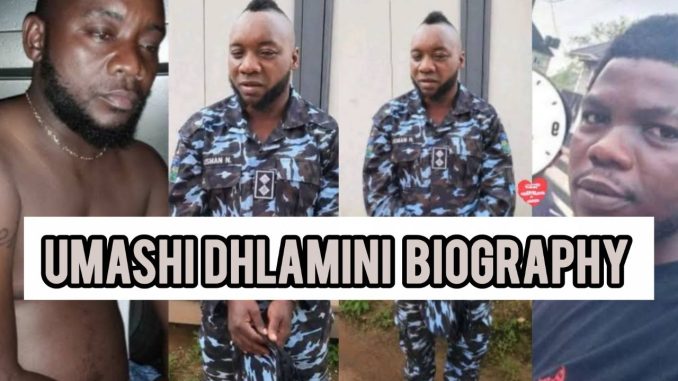
ASP Nuhu Usman Biography
ASP Nuhu Usman was born on July 23, 1988, in Delta State, Nigeria. For most of his adult life, he lived and worked in relative anonymity, known only within the corridors of the Nigeria Police Force and on the streets where he operated. That changed in April 2026, when his name became one of the most searched and debated in Nigeria — not because of any achievement, but because of an act of lethal violence that was captured on camera and watched by millions. ASP Nuhu Usman is 37 years old as of 2026.
His full name is Nuhu Usman, and he held the rank of Assistant Superintendent of Police (ASP) within the Nigeria Police Force. He was attached to the Effurun Area Command in Delta State at the time of the incident that ended his career and triggered a national reckoning. The name pattern — Nuhu Usman — is associated with northern Nigerian naming conventions, suggesting possible Hausa or Fulani roots, though his ethnic background has not been officially confirmed in any public record.
In the communities and circles where he operated, ASP Nuhu Usman was known by a far more revealing name: “Ogbegbe.” In the local dialect of the Niger Delta, the word translates roughly to “gun-shooter.” It was not a name given to him out of affection or admiration. It was a name that described a policing style — one that those who encountered him understood to mean an officer who treated his firearm as a first option rather than a last resort. A name like that does not come quietly. It accumulates over time, through patterns of behaviour that people witness, survive, and whisper about.
ASP Nuhu Usman Career
ASP Nuhu Usman entered the Nigeria Police Force through the standard route of training and commissioning, rising to the rank of Assistant Superintendent of Police — a mid-to-senior supervisory position that places an officer in command of operations, responsible for directing junior officers and overseeing enforcement activities. His career took him through various postings in Delta State, and at some point his service became linked to the controversial Rapid Response Squad (RRS), a unit widely regarded by Nigerians as the operational successor to the disbanded Special Anti-Robbery Squad, better known as SARS.
SARS was officially disbanded in October 2020 following the nationwide #EndSARS protests, during which young Nigerians took to the streets to demand an end to the squad’s well-documented pattern of extrajudicial killings, arbitrary arrests, torture, and extortion. The protests ended in tragedy at the Lekki tollgate in Lagos, where soldiers opened fire on unarmed protesters. The government promised reform. SARS was dissolved. But for many Nigerians, the culture that bred SARS never truly disappeared — it simply relocated into other units and continued under different names.
Before his posting to the Uvwie and Effurun area commands, ASP Nuhu Usman had been stationed at the Divisional Police Headquarters in Illah. His departure from Illah was not a routine rotation. According to reports gathered by investigative outlets, he was transferred out of Illah following repeated complaints from residents and internal petitions regarding his excessive use of force and his disregard for standard police engagement protocols. Rather than face a disciplinary tribunal at that point, he was quietly moved to another posting. It is a pattern familiar to those who study institutional dysfunction in large organisations: a problem officer is transferred rather than confronted, and the cycle of harm continues in a new location.
By April 2026, Usman was serving at the Effurun Area Command. On the surface, he was a senior officer fulfilling routine policing duties. Beneath the surface, he was a man whose reputation had followed him through every transfer, whose nickname told a story that the official record had chosen not to document.
ASP Nuhu Usman Scandal and Controversies
On Sunday, April 26, 2026, a 28-year-old aspiring artist named Mene Ogidi — also referred to as Ogidi Mena or Oghenemine — was at the Effurun main motor park along the Warri–Sapele Expressway when civilians at the park discovered he was in possession of a Beretta pistol with four rounds of ammunition. They alerted the police. The Uvwie Area Commander, ACP Aliyu Shaba, directed a patrol team led by ASP Nuhu Usman to pick the suspect up and bring him in to the station.
What happened next was captured on video and has been seen by millions of Nigerians. Upon arriving at the park, Usman reportedly shot Ogidi in the hand in front of onlookers. The suspect — still alive, wounded, and restrained — was placed into a patrol vehicle and transported toward Ekpan Police Station. In the car park of that station, instead of reporting to the Area Commander as instructed, officers removed Ogidi from the vehicle. ASP Nuhu Usman then allegedly fired additional shots at close range into the restrained man, killing him. The Area Commander heard the gunfire. He immediately ordered Usman and his team disarmed and detained.
“Justice will not only be done but will be seen to be done.” — Delta State Police Command, following the killing of Mene Ogidi
The video went viral within hours, flooding timelines on X (formerly Twitter), Facebook, WhatsApp groups, and Nigerian news blogs. The footage was clear and damning: this was not an accidental discharge, not a scuffle gone wrong. It was the execution of a man who posed no active threat. The Delta State Police Command’s spokesperson, SP Bright Edafe, confirmed that the actions constituted a direct violation of Force Order 237 and the Nigeria Police Force Standard Operating Procedure governing the use of firearms, which explicitly prohibit the use of lethal force against a non-threatening, restrained individual.
ASP Nuhu Usman was arrested immediately. He was first transferred to the State Headquarters in Asaba, then moved to the Force Headquarters in Abuja at the direction of the Inspector General of Police, to face the Force Disciplinary Committee for summary disciplinary proceedings and possible criminal prosecution. Reports confirmed that he was subsequently dismissed from the Nigeria Police Force and found guilty of violating police rules and misusing his firearm. Recommendations were made for criminal prosecution for unlawful killing.
The incident did not exist in isolation. Beyond Usman himself, there were at least three other officers present at the scene. Eyewitnesses alleged that these officers helped restrain the victim and did not intervene as Usman prepared to fire. Concerns emerged — and were reported by investigative outlets — that attempts were being made within certain segments of the police command to shield these accomplices from public identification in order to limit institutional fallout. Those concerns remain unresolved as investigations continue.
Nationwide, the reaction was one of grief, fury, and a painful sense of déjà vu. Hashtags demanding justice for Mene Ogidi trended across social media platforms. Activists, human rights groups, and ordinary citizens drew direct comparisons to the abuses that had fuelled the 2020 #EndSARS movement, questioning whether anything had truly changed in the five years since. The case became a test — not just of one officer’s guilt, but of the entire system’s willingness to hold its own accountable.
Conclusion
ASP Nuhu Usman’s story is ultimately about more than one officer. It is about what happens when institutional inertia shields dangerous individuals from the consequences of their actions — transfer after transfer, complaint after complaint, until one day there is a video and a dead young man and no more room to look away. The killing of Mene Ogidi at Ekpan Police Station on April 26, 2026, forced Nigeria to confront a question it has been asking since long before the #EndSARS protests: at what point does a system stop producing the “Ogbegbes” within its ranks? The answer to that question matters far more than the fate of any single officer.
FAQs
What does “Ogbegbe” mean and why was ASP Nuhu Usman called that?
Ogbegbe is a local Niger Delta term that translates roughly to “gun-shooter.” ASP Nuhu Usman earned this alias from residents and communities where he operated because of his reputation for being quick to use lethal force. The nickname was not a compliment — it described a policing style that prioritised firearms over restraint and professional engagement protocols.
What happened to Mene Ogidi?
Mene Ogidi, a 28-year-old aspiring artist, was found in possession of a firearm at the Effurun motor park on April 26, 2026. He was shot in the hand by ASP Nuhu Usman at the scene, then transported to Ekpan Police Station. At the station car park, officers removed him from the patrol vehicle and Usman allegedly shot him again at close range, killing him. The killing was captured on video and went viral across Nigerian social media.
Was ASP Nuhu Usman dismissed from the Nigeria Police Force?
Yes. Following the killing of Mene Ogidi, ASP Nuhu Usman was arrested, transferred to the Force Headquarters in Abuja, and brought before the Force Disciplinary Committee. He was dismissed from the Nigeria Police Force after being found guilty of violating police rules and misusing his firearm. He was also recommended for criminal prosecution for unlawful killing.
How does the ASP Nuhu Usman case relate to the #EndSARS movement?
The killing of Mene Ogidi reignited national conversations about police brutality in Nigeria and drew direct comparisons to the abuses that sparked the 2020 #EndSARS protests. ASP Nuhu Usman’s reported links to the Rapid Response Squad (RRS) — widely seen as a successor to the disbanded SARS unit — and his history of alleged misconduct going unpunished through repeated transfers reinforced concerns that the systemic culture that produced SARS had never truly been reformed.
Originally posted 2026-05-01 12:05:11.

Henry Jude writes about biotechnology and housing technology, focusing on the latest trends. He has 15 years of experience reporting on and analyzing advances in these fields. Holding both a BSc and an MSc in Biotechnology, he uses his scientific training to explain complex ideas clearly and show how new technologies can be applied in real life.