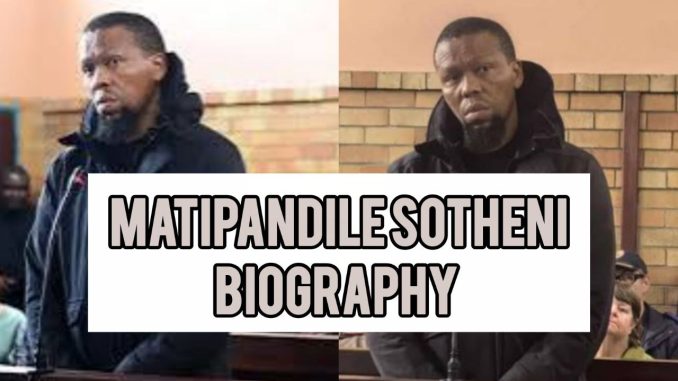
Matipandile Sotheni Biography
Matipandile Sotheni was born on October 7, 1984, in Durban, South Africa. He is a former police officer who trained with the SAPS Special Task Force and later worked in private security. He is accused of murder, conspiracy to commit murder, multiple counts of attempted murder and possession of unlicensed firearms and ammunition in connection with the k!lling of a Madlanga Commission witness. Matipandile Sotheni is 41 years old as of 2026.
Although Sotheni is now the focus of intense media attention because of criminal charges, his online footprint before this arrest was small. He appeared in labour and court records tied to an employment and allowances dispute with SAPS, which confirms he was an employee within the policing system and had access to skills-based training and allowances. That labour case does not read like a public biography, but it does confirm long-standing ties to the police and specialised roles there. He has otherwise kept a low public profile: there is little verified public information about his education, family life or private relationships beyond references in court papers and reporting.
The limited personal information that exists is important because it shows Sotheni was not previously a public celebrity or a widely-known public figure. Most reliable public knowledge about him comes from legal records and, more recently, investigative reporting that connects him to a very serious criminal case. The facts below show how a trained police operator moved into private work and then into the centre of a high-profile murder investigation.
Matipandile Sotheni Career
Sotheni’s career began in law enforcement. He joined the police in 2005 and, according to police statements and court reporting, he later earned selection into one of the service’s most elite units. In 2010 he became part of the SAPS Special Task Force — a small, highly trained tactical unit whose members receive advanced weapons, tactics and surveillance training. Officials have stated the State invested heavily in this training, at times citing figures that reflect substantial costs to develop these specialised skills. Police spokespeople stressed that training explained the precision and methods allegedly used in the incident at the centre of this case.
After nearly a decade in elite policing, Sotheni resigned from SAPS in 2019 and moved into the private security sector. This path — from government tactical work into private protection — is common in many places where former tactical officers are sought after by wealthy individuals and companies for personal protection roles.
At the time of the crime under investigation, media reporting shows Sotheni was employed as a bodyguard for a wealthy family in the Houghton area of Johannesburg, working in private security rather than as a public officer. Investigators have told reporters they do not believe Sotheni’s private employer ordered or knew about any alleged hit; authorities say the suspect’s work for that family appears unconnected to the murder, and they describe the killing as something Sotheni may have carried out outside his formal employment.
The reporting on his career also highlights a wider issue flagged by police: well-trained tactical operatives are increasingly leaving public service for higher pay in the private sector. Police spokespeople have said this trend is worrying because specialised skills trained at public expense then enter the private market, sometimes creating risks when former officers are recruited by wealthy individuals or others who can pay more than government salaries. That broader context helps explain why the policing authorities carefully noted Sotheni’s elite background when announcing the arrest.
Matipandile Sotheni Accusation & Scandal
The most serious and public part of Sotheni’s story is the accusation that he was the gunman who killed a witness linked to the Madlanga Commission. On 5 December 2025, Marius van der Merwe — who testified as “Witness D” at the commission and had given evidence about alleged torture and wrongdoing involving members of the Ekurhuleni Metro Police — was shot and killed outside his Brakpan home in full view of his wife and two young children. That killing sparked national shock and an investigation that linked the murder to testimony he had given to the commission.
Investigators say Sotheni was arrested on 14 March 2026 and made a brief first court appearance at the Brakpan Magistrate’s Court on 16 March 2026. He faces multiple charges, including murder, conspiracy to commit murder, three counts of attempted murder (related to members of the victim’s family), and possession of unlicensed firearms and ammunition. Police say he was found with dozens of live rounds the accused was not authorised to hold, and that investigators are still searching for an AK-47 believed to have been used in the attack. The court hearing was adjourned and the matter was set down for a formal bail application on 25 March 2026.
Authorities have described Sotheni as a highly trained former officer whose “sniper-like” skills made him an effective, precise shooter. National police spokespeople said they believed someone recruited Sotheni because of those specialised skills and that he carried out the killing as a “side hustle” under instructions from others. Media reports have also linked another individual, Wiandre Pretorius, who took his own life in February, as the alleged driver in the Suzuki Swift used to tail and then shoot the victim; police say the vehicle was later traced to Sotheni’s girlfriend. Investigators continue to look for the person or people who ordered the killing.
The charge sheet, as reported in multiple outlets, says Sotheni did not personally know the victim and allegedly procured an AK-47 specifically to commit the killing. When arrested, police seized large quantities of live ammunition — quantities the accused was not permitted to possess according to the charge sheet. The State has signalled its intention to oppose bail, arguing the charges are extremely serious and fall into the highest scheduling of offences. Police spokespeople said the investigation remains active and that more arrests are not ruled out as they follow leads to the people who may have planned or ordered the murder.
The murder deeply affected the victim’s family. Marius’s sister has spoken publicly about the toll it has taken and about the death threats some family members say they received after the killing. Police have said they will investigate those threats and are working with the family while balancing the need to protect the integrity of the investigation. The emotional impact on a family who lost a husband, father and brother in front of their eyes helps explain the public interest and the pressure on investigators to bring all responsible parties to justice.
What the State must prove and what is still unknown
It is important to emphasise that everyone charged in a criminal case is entitled to a fair trial and presumed innocent until convicted. The public reporting lists the charges and the evidence police say they have found, but a court will decide guilt or innocence after the State presents its case and the defence responds. At the time of writing, some key items remain unaccounted for in public reporting: the AK-47 allegedly used in the killing has not been recovered, and police say the alleged mastermind who ordered the murder remains at large. The investigation is ongoing and further evidence may emerge in the coming weeks.
Conclusion
The case of the man charged in the killing of a Madlanga Commission witness is a story of a trained former police operator who moved into private security and now faces the most serious criminal allegations. Public reporting shows Sotheni’s pathway from SAPS training to private work, and police say his skills made him a sought-after but potentially dangerous figure when used outside lawful bounds. The charges are grave and carry heavy legal consequences if proven. For now, the facts in the public domain come from court papers, statements from police spokespeople, and investigative reporting; the legal process will determine guilt or innocence in a court of law.
FAQs
When and where did the killing of the witness happen?
The killing occurred on 5 December 2025 outside the victim’s home in Brakpan, Ekurhuleni. The victim was shot in a drive-by attack in full view of his wife and children after he had testified to the Madlanga Commission.
Was the weapon used in the murder recovered?
As of the latest reporting, police say the AK-47 alleged to have been used in the killing has not been found. Investigators continue searching properties and following leads about the missing weapon.
When did Sotheni appear in court and what is the next date to follow?
Sotheni made a first appearance in the Brakpan Magistrate’s Court on 16 March 2026. The matter was postponed and a formal bail application was scheduled for 25 March 2026.
How does this case relate to the Madlanga Commission?
The victim had given testimony at the Madlanga Commission that implicated certain policing officials in alleged torture and other crimes. Investigators say the killing came after that testimony and that the victim’s role as a witness is a key reason the State opened the investigation into his murder. Authorities have said they believe others ordered the killing and are still searching for those persons.
Originally posted 2026-03-17 09:33:30.

Henry Jude writes about biotechnology and housing technology, focusing on the latest trends. He has 15 years of experience reporting on and analyzing advances in these fields. Holding both a BSc and an MSc in Biotechnology, he uses his scientific training to explain complex ideas clearly and show how new technologies can be applied in real life.